You've got your country assignment. Maybe it's Germany or Nigeria or Bhutan. Maybe it's a country you know well, or maybe it's one you had to look up on a map. Either way, the clock is ticking, the conference is weeks away, and somewhere between now and then you need to become, at least for the purposes of one committee room, a genuine expert on how this country thinks and votes.
MUN country research sounds daunting. It doesn't need to be. There's a clear process, a set of reliable free sources, and a sensible way to use modern AI tools to speed things up without falling into the traps that trip up a lot of delegates. This guide walks you through all of it, from the first Google search to a fully formed position you can defend in the room.
If you're newer to MUN and still figuring out the basics, our beginner's guide to your first MUN conference covers what to expect on the day. And if you're wondering what Model UN actually is, start here. This article assumes you have your assignment in hand and are ready to dig in.
Why country research matters
Here's the honest version: delegates who skip proper research get found out quickly. A chair can tell within the first few speeches who has done the work and who is winging it. More importantly, your ability to negotiate, to build alliances, and to contribute meaningfully to a resolution all depend on knowing your country's real position, not a vague impression of it.
Research is also the foundation of your position paper. You can't write a persuasive, well-sourced position paper on a blank factual canvas. Every argument you'll make in committee, every bloc you'll join, every amendment you'll support or oppose traces back to what you found in your research phase. Get this right and everything downstream becomes easier.
Think of it as building the mental model you'll draw on for two or three days of debate. The more solid and detailed that model is, the more confident and effective you'll be when it matters.
What you actually need to find
Before you open a single browser tab, it's worth knowing what you're looking for. Unfocused research produces a pile of loosely related facts that's hard to turn into a position. Focused research produces exactly what you need.
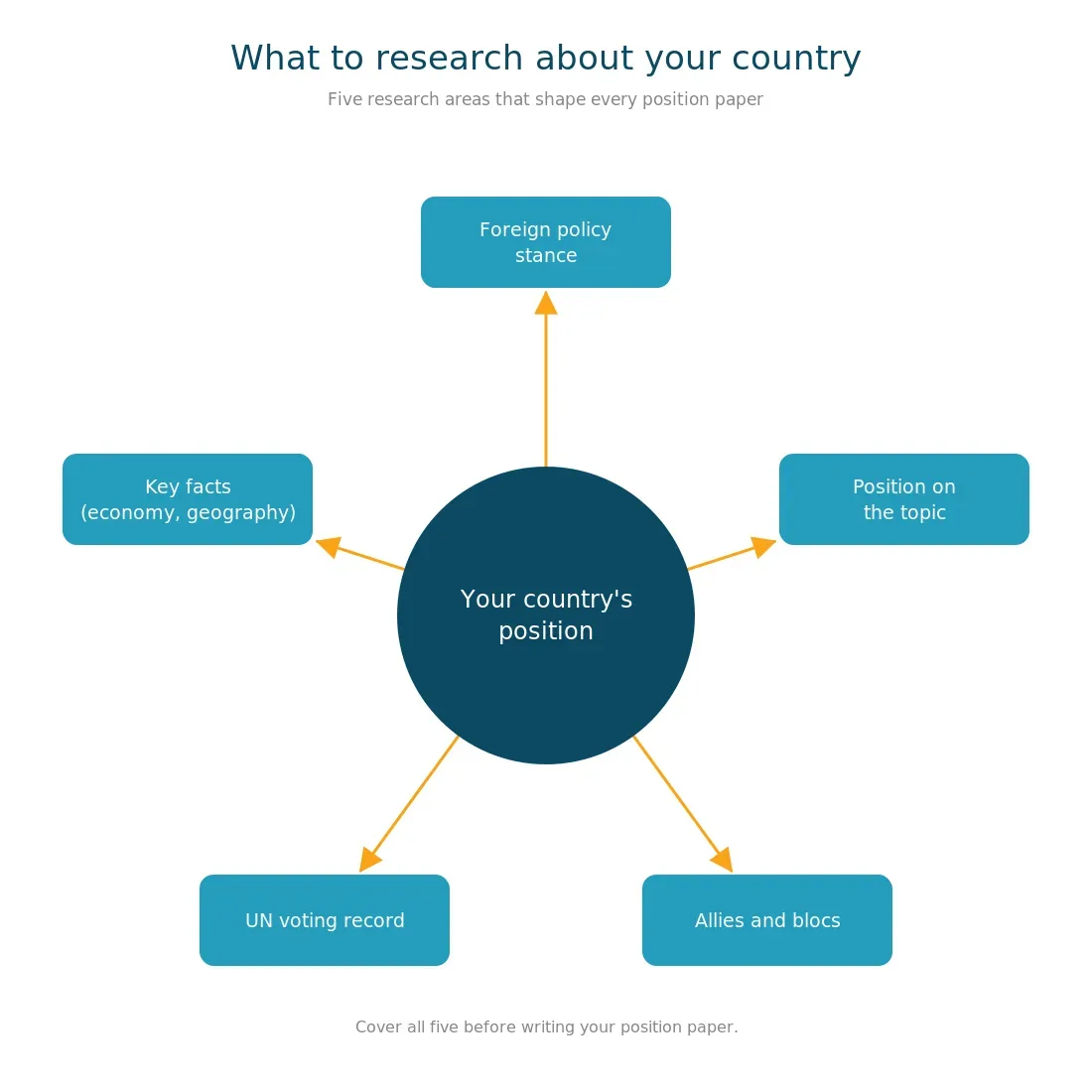
Here's the core of what you're after:
Your country's general foreign policy stance. Is it non-aligned, part of a regional bloc, historically close to a particular great power? Does it tend to prioritise state sovereignty, or does it champion multilateral intervention? These broad orientations shape every specific vote.
Your country's position on your specific topic. This is the main event. How has your country spoken about this issue at the UN? Have they co-sponsored resolutions on it? Blocked them? Stayed quiet?
Key allies and blocs. Which countries tend to vote with yours? Are there regional groupings (African Union, EU, ASEAN, G77) your country belongs to? Blocs are where resolution drafting actually happens, and knowing yours in advance saves a lot of time in committee.
Past UN votes on related topics. This is your most reliable evidence for a country's real position, and it's often more revealing than official statements.
A few grounding facts. GDP, population, geography, major industries, recent history relevant to the topic. These give your speeches texture and credibility.
The best free research sources
This is the section to bookmark. These are the actual sites that experienced delegates use, and they're all free.
UN General Assembly records and documents. The UN Digital Library is indispensable. You can search by country, by topic, and by document type. Official statements, resolutions, and meeting records are all here. If your country delivered a speech on your topic at the General Assembly, it's in here somewhere.
UN voting records. The UN General Assembly Vote Records database lets you search how countries voted on specific resolutions. This is your primary source for a country's real position. Filter by topic or resolution number and look at how your country voted, especially in the last five to ten years. Consistent patterns here tell you far more than press releases.
UN Bibliographic Information System (UNBIS). A deeper archive of UN speeches and documents. Useful when the Digital Library search returns too little.
CIA World Factbook. The World Factbook covers every country in the world with standardised sections on government, economy, geography, and international disputes. It's not always up to the minute, but it's reliable, well-organised, and a genuinely useful starting point for any unfamiliar country.
The country's own UN mission website. Most countries maintain a Permanent Mission to the United Nations in New York. These pages carry official statements, speeches, and policy positions directly from the source. Search for "[country name] permanent mission United Nations."
Reputable international news sources. The BBC, Reuters, Al Jazeera, Foreign Policy, and The Guardian all cover international relations with enough depth to contextualise your country's position. For regional context, look at outlets that cover your country's region specifically.
Freedom House, Human Rights Watch, Amnesty International. If your committee topic touches on human rights, governance, or civil liberties, these organisations produce detailed country-level reports that can give you both facts and the framing your country's opponents may use.
Wikipedia as a starting point, not an ending point. Wikipedia country pages and pages on specific UN issues are genuinely useful for getting oriented. Follow the citations to the primary sources rather than quoting Wikipedia in your position paper.
Using AI the smart way
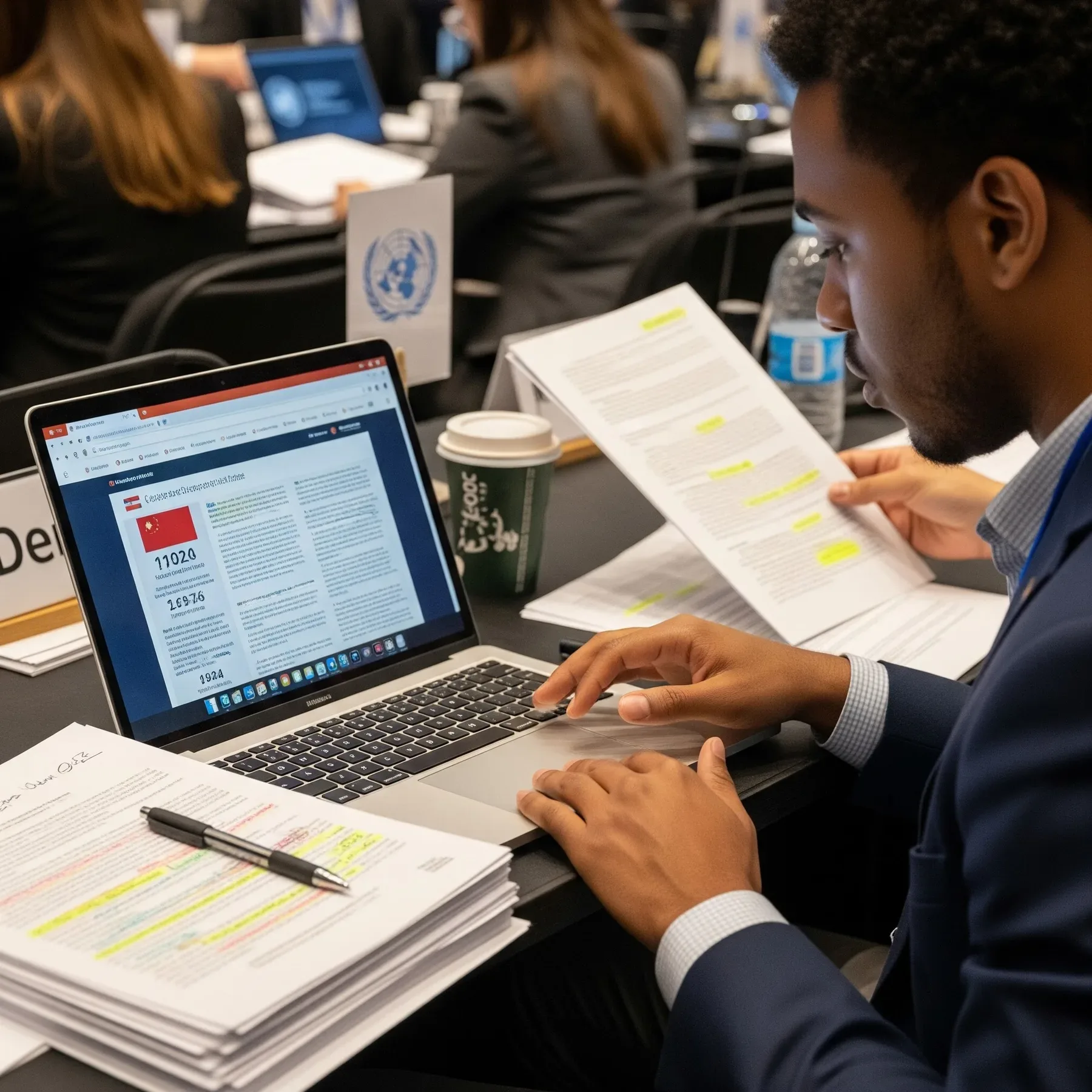
Delegates are increasingly using ChatGPT, Claude, and similar tools in their research process, and used well, they can meaningfully cut the time it takes to get up to speed. Used badly, they can land you in embarrassing trouble in committee.
Here's what AI tools are genuinely good for in MUN research:
Summarising complex policy areas. If your committee topic is something like "digital sovereignty and data localisation laws," an AI can give you a clear plain-language overview of the landscape in minutes, saving you an hour of reading before you even know what to look for.
Organising what you already know. Once you've gathered facts and sources, you can ask an AI to help you structure them into a coherent position narrative. "Here are five things I know about Brazil's stance on climate finance. Help me identify the through-line." That's a good use of the tool.
Drafting structures. AI can generate a first-draft outline for your position paper or opening speech that you then revise with your actual research. It's faster than starting from a blank page, as long as you treat it as scaffolding, not finished content.
Translating and explaining source documents. If an official UN document or a foreign ministry statement is hard to parse, AI can help you understand what it actually means.
Here's where you have to be careful.
Never trust an AI-stated country position without checking the actual voting records. This is the most important rule. AI language models are trained on text that is imperfect, sometimes out of date, and sometimes simply wrong about specific foreign policy positions. A model might tell you, fluently and confidently, that a country supports a particular type of UN intervention when the country's actual voting record shows the opposite. Always verify against the UN Digital Library.
Watch for hallucinated citations. AI models sometimes produce plausible-sounding but entirely fabricated document titles, report names, and resolution numbers. If an AI gives you a source citation, look it up before you use it. A position paper with a fake citation can cost you credibility with a chair who checks.
Use AI to accelerate primary source research, not replace it. The best delegates use these tools to narrow down what to look for and to make sense of what they find, but they do the actual fact-finding in real sources. The research process is also the learning process: reading actual UN speeches is how you develop a feel for diplomatic language, and that feel is what makes your own speeches land.
Turning research into a position
At a certain point you have to stop gathering and start synthesising. You've got facts, voting records, a sense of your country's alliances: now what?
Write down three things in plain sentences. First, what your country wants on this topic. Second, what your country is against. Third, who your country is most likely to work with.
That three-sentence summary is the seed of your position paper and the foundation of everything you'll say in committee. It's the moment your research stops being a pile of notes and becomes a perspective.
From there, the next step is your position paper: the formal document that lays out your country's stance, the evidence behind it, and the solutions your country will advocate for. We've covered that process in depth in our complete guide to crafting a position paper, and it's the natural next stage once your research is solid.
A quick research checklist
Before you close your tabs and call it done, run through this list.
- [ ] I know my country's general foreign policy orientation (non-aligned, regional bloc, great-power alignment).
- [ ] I've found at least three UN votes my country has cast on this topic or closely related ones.
- [ ] I know which countries or blocs my country typically aligns with.
- [ ] I've read at least one official statement from my country's UN mission on this topic.
- [ ] I have a clear, defensible one-paragraph summary of my country's position.
- [ ] I've verified any AI-generated claims against a primary source.
- [ ] I have enough grounding facts (geography, economy, relevant history) to give my speeches texture.
- [ ] I know what my country's red lines are: what they would never agree to in a resolution.
That last one matters more than it might seem. Knowing what your country won't accept is what tells you when to walk away from a bloc, when to push back on a working paper, and when you need to negotiate harder. It's the difference between representing a country and just performing one.
Good research is what makes the rest of MUN feel like diplomacy rather than guesswork. Put the time in now, and the committee room will feel like home.