About
Ajar. Amar. Atal.
Unwavering. Unshakeable. Undefeated.
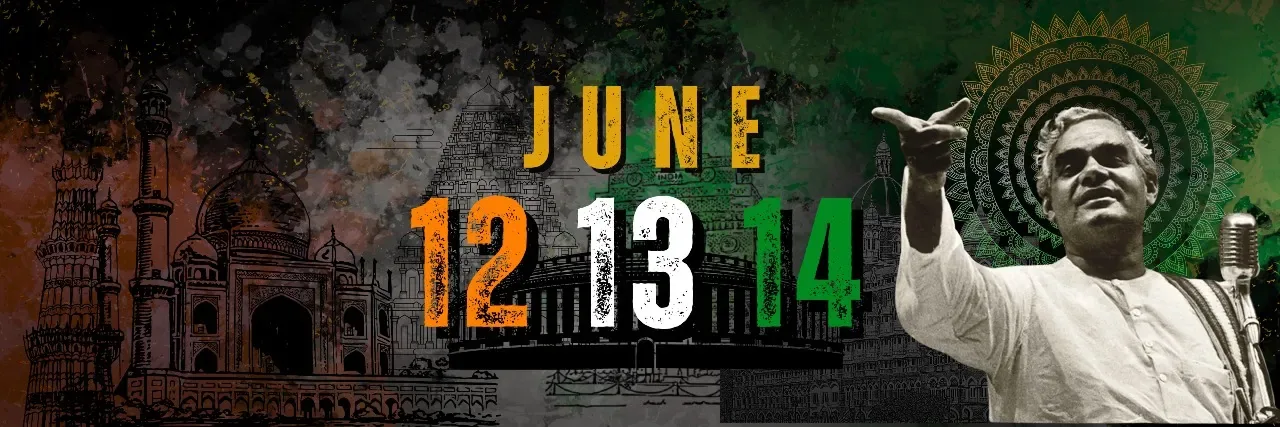
More than words, these ideals define the spirit of ATAL YUVA SANSAD, a youth parliament inspired by the timeless legacy of Shri Atal Bihari Vajpayee Ji. A leader whose resolve was firm, whose integrity shaped an era, and whose vision continues to guide the nation. Rooted in the belief of “अजर,अमर,अटल”, this conference is a platform where conviction meets responsibility, ideas transform into action, and youthful passion is channeled into nation-building.
ATAL YUVA SANSAD will be held on 12th, 13th & 14th June in the historic city of Gwalior.
Gwalior, a city of valor, culture, and intellect, has long stood as a symbol of courage and leadership. From its majestic fort to its rich democratic and cultural heritage, Gwalior inspires strength in thought and clarity in vision, making it the perfect host for a conference that empowers young voices to shape India’s future.
Here, youth come together to debate with purpose, lead with ethics, and act with accountability. ATAL YUVA SANSAD is not just a conference. It is a journey shaped by steadfast ideas, democratic values, and the living legacy of Atal Ji, where tomorrow’s leaders rise with confidence, conscience, and commitment
Committees
All India Student Leaders’ Meet (AISLM)
46 seats · EnglishAISLM exists because student issues are almost always discussed loudly and governed poorly. Education, employment, mental health, and institutional access affect millions, yet rarely receive serious legislative treatment. This committee treats students not as a vote bank or audience, but as participants in policy-making. It asks one simple question: what happens when youth opinion is backed by responsibility? Delegates are expected to move beyond demands and into design. Ideas must survive feasibility and long-term impact. Passion without planning collapses quickly in this room. AISLM rewards those who can convert concern into policy. The committee mirrors how reform actually happens, through negotiation and constraint. Delegates learn that change is rarely dramatic but always deliberate. It builds political maturity early. Idealism is welcome, but discipline decides outcomes. Choosing AISLM means choosing seriousness over metaphors. It is for those who want their voice to matter beyond slogans. The committee prepares delegates for real engagement with governance, not just debate.
United Nations Security Council (UNSC)
35 seats · EnglishThe UNSC is where power stops pretending to be equal. Decisions here affect war, peacekeeping, sanctions, and humanitarian intervention. This committee does not reward moral speeches; it tests strategic thinking. Reality dominates the room. Delegates must balance ethics with national interest. Every move has consequences beyond intent. Alliances matter. Silence matters. Timing matters more than volume. The UNSC exposes how global order is actually managed. This committee forces uncomfortable clarity: law is shaped by power, not insulated from it. Delegates confront veto politics, crisis escalation, and diplomatic deadlock. It is intense and unforgiving. Choosing UNSC means choosing a challenge. It is for the delegates who think several steps ahead. The committee sharpens strategic restraint and political realism like no other.
United Nations Human Rights Council (UNHRC)
47 seats · EnglishUNHRC exists to ask questions most states would rather avoid. It examines violations that sit between law, morality, and political inconvenience. This committee is not emotional; it is evidentiary. Credibility is everything. Delegates work with reports, documentation, and international frameworks. Allegations must be precise, measured, and defensible. Recklessness weakens justice here. The committee rewards control and clarity. UNHRC also exposes limits. Accountability is constrained by diplomacy and power. Delegates learn how rights are defended within imperfect systems. This tension defines the room. Choosing UNHRC is choosing responsibility. It suits those interested in law, ethics, and global justice. The committee builds disciplined advocacy, not outrage.
Bharatiya Mahila Sansad (Indian Women Council)
60 seats · EnglishBharatiya Mahila Sansad places women at the center of lawmaking as political actors shaping the future. It doesn’t treat women as an afterthought or a “special issue.” It examines governance through representation, access, and institutional reform, and it rejects tokenism outright. Deliberations focus on the real foundations of equality: safety, labor rights, healthcare, education, and political participation. Delegates are expected to go beyond isolated incidents and address the systems that create inequality in the first place. Solutions must be enforceable and practical, because sensitivity alone is not enough in the real world. BMS challenges delegates to legislate with precision and clarity. It shows how exclusion weakens institutions and how inclusion strengthens them, not just morally, but structurally. This committee values nuance over noise, and policy over performative statements. Choosing BMS is choosing impact with intent. It suits delegates who want to build and reform laws, not just debate them. The committee reinforces a simple truth: equality is not optional: it is foundational.
Lok Sabha
71 seats · EnglishThe Lok Sabha is where democracy stops being theoretical. It is where policy is questioned in real time, authority is tested, and governance is held accountable before the nation. Every law that affects citizens must survive scrutiny here. This committee captures the tension, urgency, and responsibility of parliamentary power. What distinguishes Lok Sabha from other forums is its pace and pressure. Delegates must think on their feet during Question Hour, respond with precision, and defend positions under sustained opposition. There is no space for rehearsed rhetoric. Political awareness, procedural command, and strategic restraint are essential. The committee also teaches an often-overlooked truth: governance is not about winning arguments but managing disagreement. Delegates experience how consensus is built, how opposition functions as a safeguard, and how procedure disciplines ambition. It mirrors democracy as it actually functions: imperfect yet resilient. Choosing Lok Sabha is choosing intensity. It is demanding and deeply realistic. Delegates leave with a clearer understanding of how power is exercised, limited, and challenged within the constitutional framework.International Press Corps
60 seats · EnglishThe Indian Press Corps exists because democracy doesn’t survive on elections alone; it survives on information. In a politically charged, digitally saturated India, the press is either a bridge or a battlefield between truth and perception. IPC asks the question everyone fears: who watches the watchdog? This committee is where freedom of expression meets ethical restraint. IPC’s power is influence, not authority. Journalism here is accountability. Every article must expose motives, track consequences, and question the powerful. Investigative reporting digs beneath the surface, while editorials interpret policy through evidence, not opinion. Photography and caricature are IPC’s language of truth. A photograph is evidence, capturing the moment when diplomacy turns into power-play. It must tell the story without words. Caricature is criticism distilled: satire that exposes hypocrisy, reduces propaganda to its core, and forces the public to confront reality. Both must be meaningful and fearless. Press freedom cannot be defended blindly, and regulation cannot be justified casually. Delegates must navigate grey zones: security vs transparency, public interest vs sensationalism, dissent vs disorder. It rewards clarity over noise, depth over drama, and precision over passion. If you want to shape narratives, IPC doesn’t entertain you, it sharpens you.
Organizers
More MUN conferences
IndiaMUN conferences in India AsiaMUN conferences in Asia June 2026MUN conferences in June 2026 High school MUNMUN conferences for high school students University MUNMUN conferences for university students
ConferencesIndiaAYSansad 2026